


VAL
Virtual OTA Validation — Validate software updates on simulated devices before deploying them to real hardware.
tQCS works with LG Electronics to deliver LG VAL to customers, supporting the evaluation, integration, and application of virtual OTA validation within the customer’s development environment. LG develops the validation platform; tQCS supports the customer-facing work — assessing fit, integrating the solution with the customer’s systems and OTA environment, and providing ongoing technical support.
One Core, Product-Specific Plug-ins
The platform is split into a fixed core and plug-ins for each product family.
Core: scenario engine, execution control, input validation, common test actions, and logging and reporting.
Plug-ins: add the communication protocol for a specific product family. Reference plug-ins are provided as a starting point.
Test server: simulates the real protocol traffic between the OTA system and the target device.
When a new product family is added, the core stays the same and only the plug-in changes.
| Product family | Protocols covered by plug-ins |
|---|---|
| Vehicles | DoIP, CAN |
| Robots | TCP, Modbus TCP |
| IoT devices | MQTT, HTTP REST |
| Home appliances | Raw TCP |
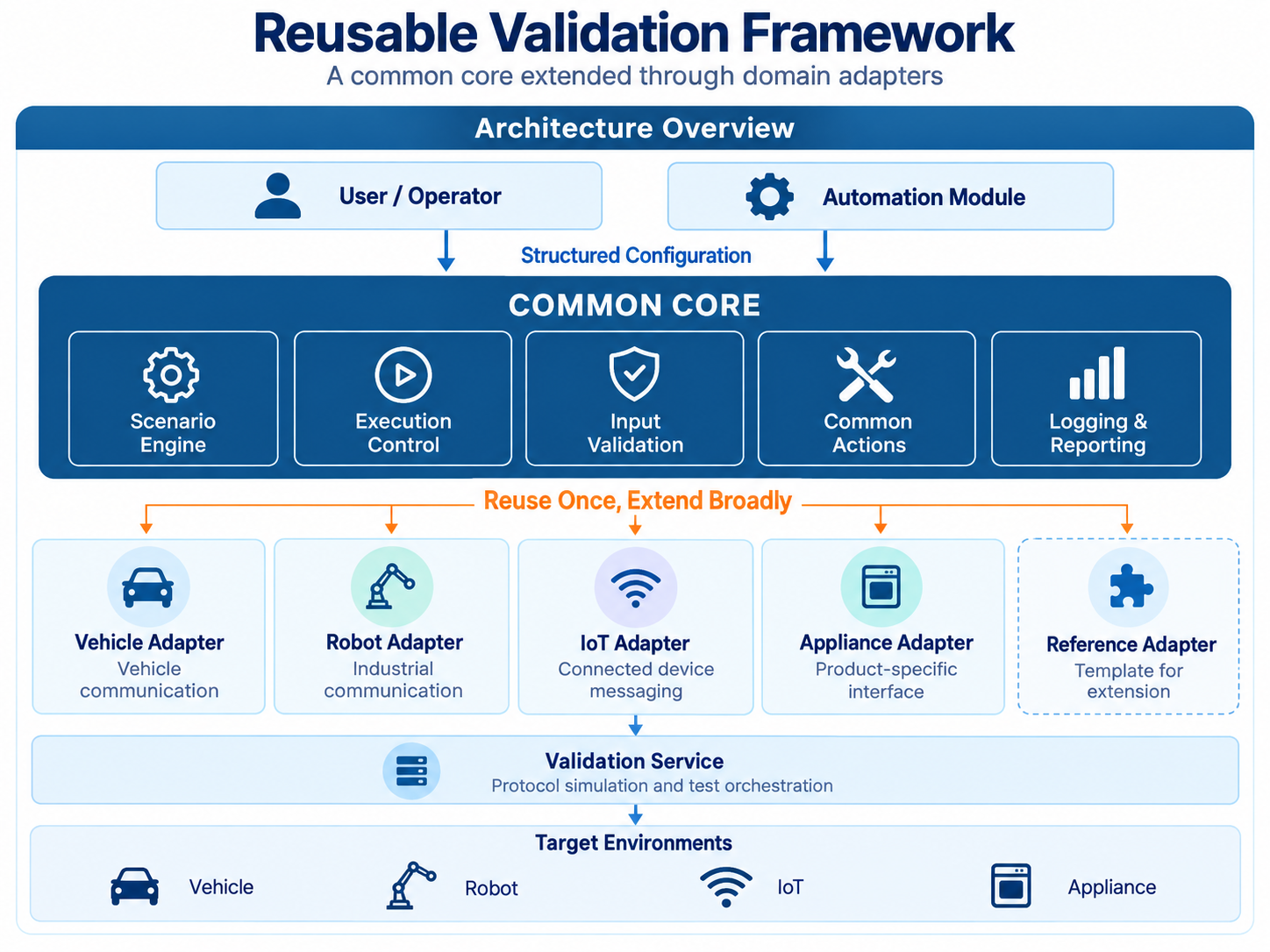
The LCOS(LG Common OTA Validation Platform) architecture is designed so that the common validation core is reused while product-specific protocols are handled through plug-ins.
This enables the same core architecture to support different target environments without rebuilding the validation platform for every product family.
LCOS has been utilized with RTOS-based IoT devices and automotive environments.
Test Scenarios, Written by Engineers or AI
Test scenarios are written in YAML or JSON. They can be written by an engineer, or generated by an AI module connected to the platform. The same AI module reads the execution logs afterwards and reports what failed and why, which cuts down the time spent digging through logs by hand.