

OxidOS is a Rust-based secure operating system ecosystem for safety-critical automotive ECUs.
Built on the open-source Tock operating system, OxidOS combines a Rust-based kernel with independently compiled user-space applications and automotive-specific modules and development tools.
Its architecture separates the kernel from applications and runs applications in isolated memory sandboxes, helping protect system resources and limit direct access to underlying hardware.
Key Advantages
Rust-based architecture for safety-critical ECUs
OxidOS uses Rust as the foundation of its operating-system architecture, bringing compile-time memory and thread-safety mechanisms into embedded automotive software development.
The platform is designed specifically for safety-critical automotive ECUs and medium-size microcontrollers, where predictable execution, isolation, and controlled access to system resources are particularly important.
Kernel and application separation
OxidOS separates the kernel from user-space applications rather than combining all system functionality into a single software image.
Applications can be compiled independently, allowing individual vehicle functions to remain isolated from the core operating system and from other applications.
Sandboxed applications
Each OxidOS application executes within its own memory sandbox and does not have unrestricted direct access to the underlying hardware.
This architecture combines software isolation with hardware memory-protection mechanisms to provide stronger separation between applications and system resources.
Secure application deployment
OxidOS applications can use cryptographic credentials and digital signatures, adding another layer of control over which software is permitted to execute within the system.
Combined with memory isolation, this approach is designed to strengthen security and software integrity for automotive ECU applications.
Rust and legacy software integration
OxidOS supports applications written in Rust as well as C/C++, allowing automotive teams to introduce Rust while continuing to use existing software components where required.
This enables a more incremental migration path rather than requiring established automotive software to be rewritten immediately.
Built on an open-source foundation
OxidOS is developed as an industrial automotive solution on top of Tock, an open-source embedded operating system written in Rust for resource-constrained devices.
OxidOS extends that foundation with proprietary modules and capabilities intended for automotive specifications and integration requirements.
Arm and RISC-V support
OxidOS is designed for embedded automotive platforms using both Arm and RISC-V architectures.
OxidOS specifically identifies applications such as zone ECUs, Hardware Security Engines, and hypervisor-related environments as areas suited to its architecture.
Web-based development tools
The OxidOS ecosystem also includes browser- and cloud-based development tools intended to simplify application development and deployment without requiring a complete local tool installation.
These tools form part of OxidOS's broader approach to software-defined vehicle development.
Where OxidOS Fits
Automotive ECUs
Deploy isolated Rust or C/C++ applications on embedded controllers using a secure operating-system architecture designed around automotive ECU requirements.
Zone Controllers
Use OxidOS on increasingly capable zone ECUs where multiple vehicle functions need to coexist while maintaining separation between applications and system resources. OxidOS explicitly positions zone-ECU solutions as one of its target areas.
Hardware Security Engines
Apply OxidOS's sandboxing, memory protection, and controlled application model to security-focused embedded systems such as Hardware Security Engines.
RISC-V and Arm Platforms
Develop automotive embedded software across both Arm- and RISC-V-based hardware while retaining the same OxidOS architectural model.
Existing C/C++ Automotive Software
Introduce Rust-based components while retaining existing C/C++ applications, enabling teams to adopt Rust incrementally rather than replacing an established codebase at once.
Whether you are evaluating OxidOS for a safety-critical automotive ECU, introducing Rust alongside an existing C/C++ codebase, developing software for Arm or RISC-V platforms, or looking for OxidOS integration and engineering support, talk to us about your requirements.
Considering OxidOS for Your Product?
Contact us
tQCS Limited.
Unit 01, 82F, International Commerce Centre, 1, Austin Road West Kowloon, Hong Kong
+852 2824 8796
Project.OxidOS@tqcs.io
business registration 68326347
Something to Consider
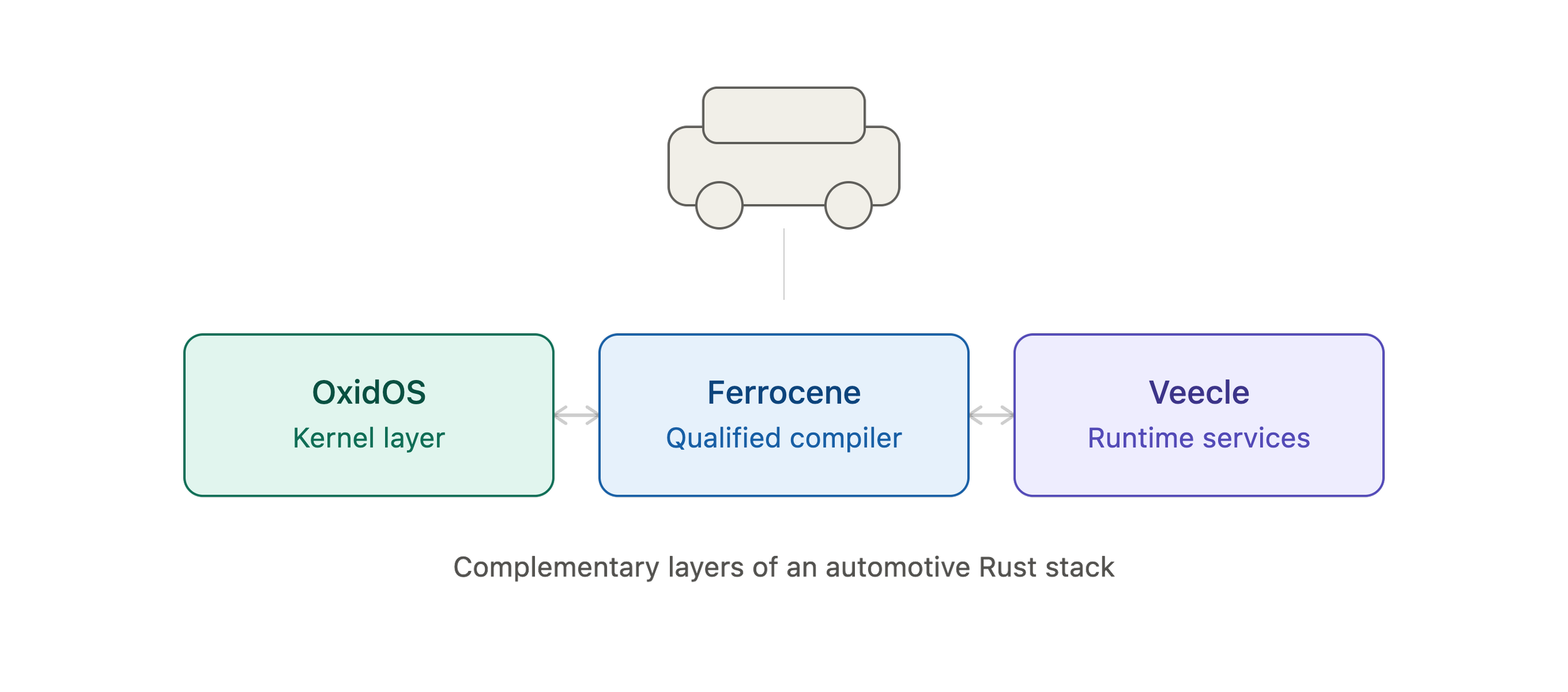
OxidOS and Veecle as complementary automotive platforms around Ferrocene