What TSN Does
TSN Technologies:
TAS, CBS, FRER, YANG / NETCONF / RESTCONF
Time Aware Shaper
IEEE 802.1Qbv, Time-Aware Shaper (TAS) is required to ensure deterministic and reliable communication in modern network environments. Traditional Ethernet networks are prone to variable delays and interruptions, which are unacceptable for time-sensitive applications of modern network environments such as automotive systems, industrial automation, and real-time audio/video streaming. TAS provides a mechanism to separate time-critical traffic from non-critical traffic, minimizing delays and ensuring timely data delivery. This is crucial for applications that require precise timing and minimal latency.
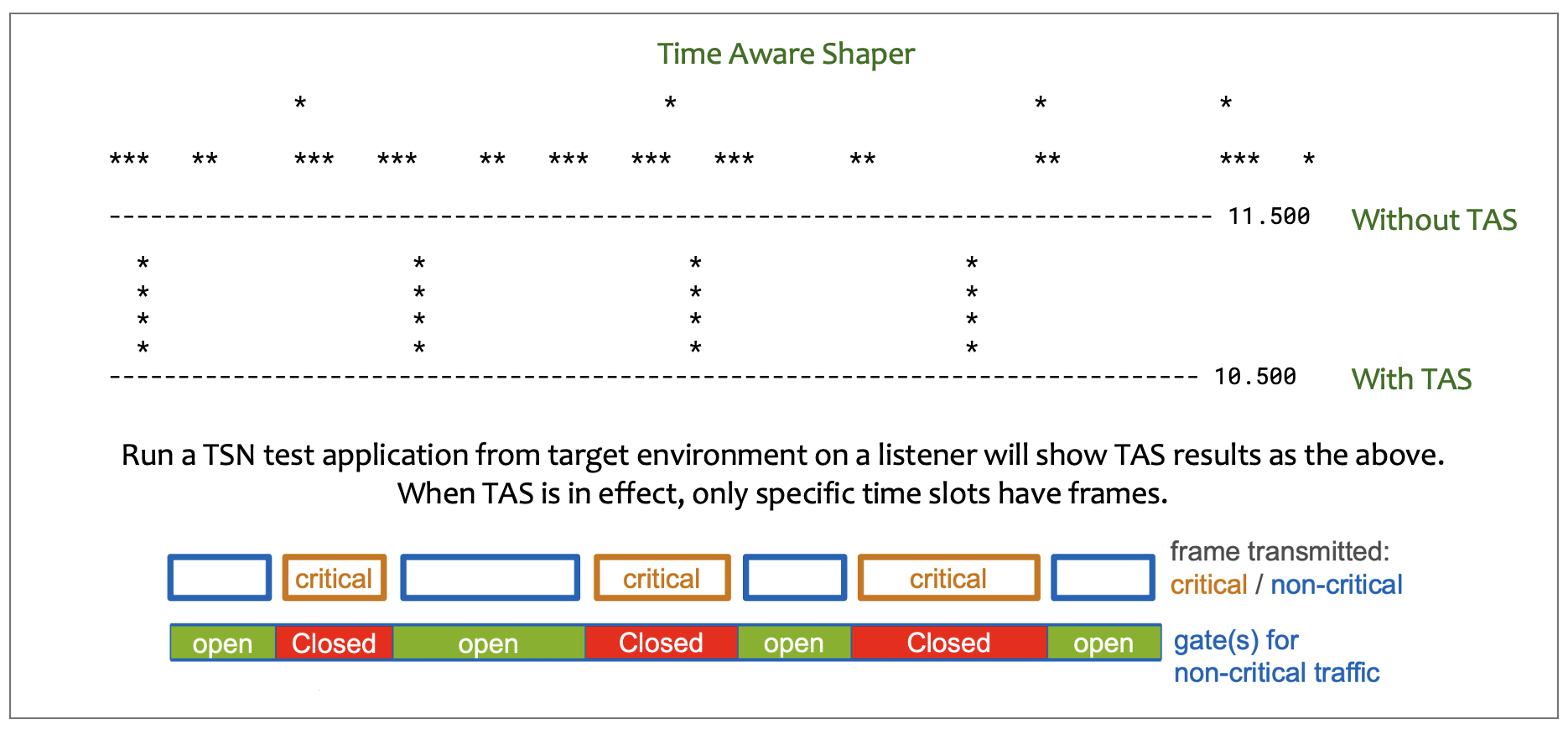
TAS is designed to separate the communication of Ethernet network into fixed length, repeating time cycles. Within these cycles, different time slots can be configured to be assigned to one or several of Ethernet priorities. Through TAS, it is possible to allocate exclusive use - for a limited time - to the Ethernet transmission medium for those traffic which need transmission reliability and shouldn’t be interrupted.
By granting exclusive access to the transmission medium and devices to time-critical traffic classes, the buffering effects in the Ethernet switch transmission can be avoided and time-critical traffic can be transmitted without non-deterministic interruptions. TAS introduces stream reservation class for time-critical control data, with worst-case latency of 100 μs over 5 hops, and maximum transmission period of 0.5ms.
Credit Based Shaper
IEEE 802.1 Qav, Credit-Based Shaper (CBS) is essential to manage network congestion and ensure predictable and controlled transmission of Ethernet frames. Traditional Ethernet networks often face issues with buffering and unpredictable delays, which can disrupt time-critical applications. Without CBS, network traffic could become congested, leading to increased buffering and unpredictable delays. This would negatively impact the performance and reliability of time-critical applications, causing high-priority data to experience latency and variability.
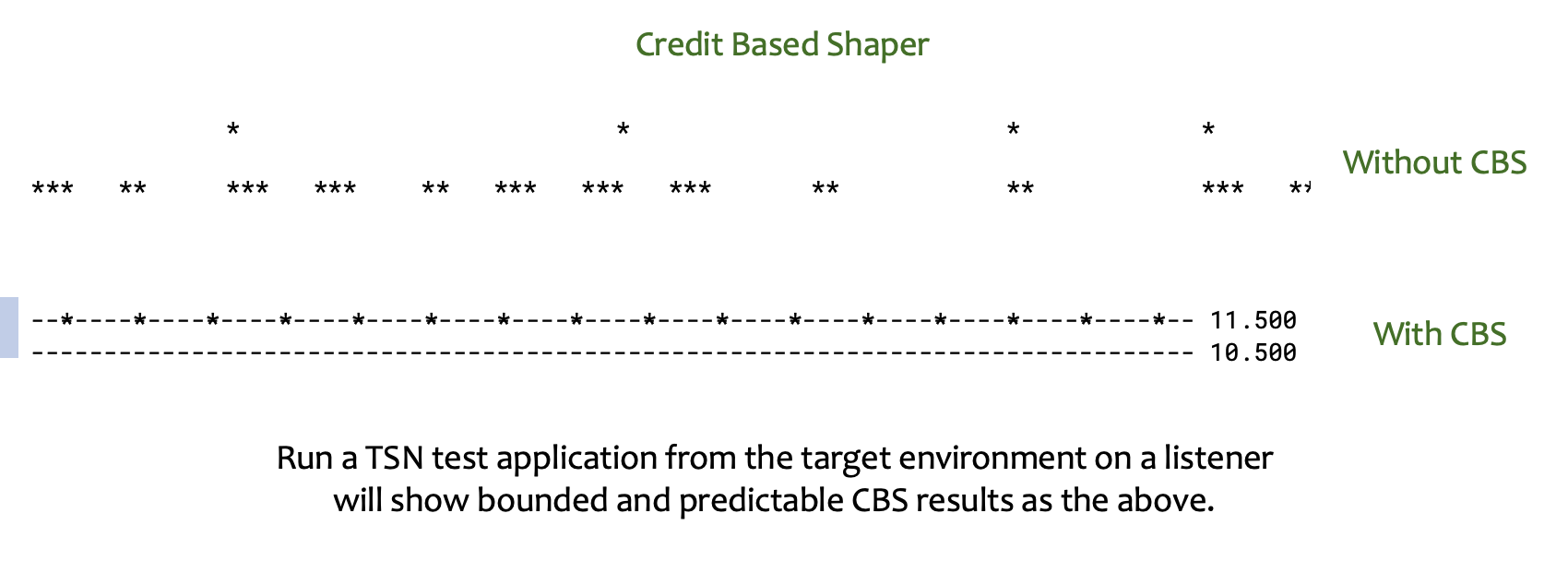
CBS is designed to reduce buffering in receiving bridges and end-points. By managing and regulating the transmission rate of Ethernet frames, CBS offers better control and predictability for time-critical traffic. It helps prevent network congestion and guarantees bounded latency, ensuring that important data is transmitted without undue delay.
CBS allocates a certain number of credits to each talker, allowing them to transmit frames only when they have sufficient credits available, consuming one credit per frame. By regulating the transmission rate and assigning credits to different traffic queues, such as Class A and Class B, CBS ensures that traffic can be predictable in avoidance of congestion. Frame transmission is only allowed when the corresponding credit is non-negative, providing the necessary bandwidth for high-priority traffic. This mechanism prevents delays caused by lower-priority traffic, improving overall network performance and reliability for applications requiring precise timing and minimal latency.
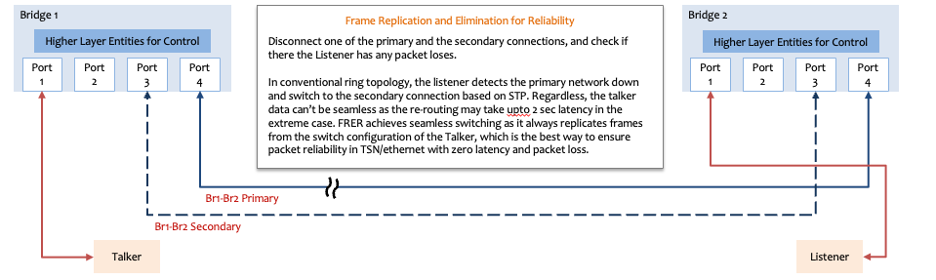
FRER, Frame Replication and Elimination for Reliability
IEEE 802.1CB, Frame Replication and Elimination for Reliability (FRER), provides proactive seamless redundancy for control applications that cannot tolerate packet losses by sending duplicate copies of each frame over multiple disjoint paths. This approach ensures that if one path fails, the duplicate frames can still be delivered via alternative paths, maintaining reliable communication. FRER is essential for future-oriented network architectures such as zonal configurations where uninterrupted data flow is important are crucial even in network disruptions. Compared to statically connecting all ports, FRER reduces costs and complexity by dynamically replicating frames over multiple disjoint paths.
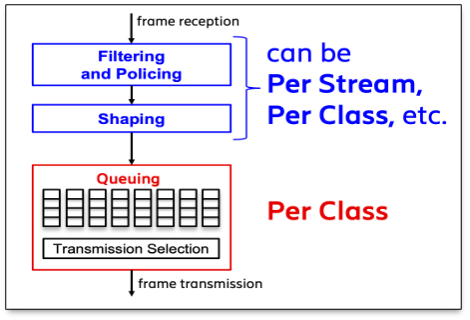
To minimize network congestion, packet replication utilizes traffic class and path information. Each replicated frame includes a sequence identification number, which is used to reorder and merge frames, as well as to discard duplicates. This ensures that the receiving system processes the frames correctly without unnecessary delays or errors.
FRER requires centralized configuration management and is typically used in conjunction with IEEE 802.1Qcc (Centralized User Configuration - Centralized Network Configuration model) and IEEE 802.1Qca (Path Control and Reservation) to manage and optimize the network paths and resources effectively.
YANG-based Netconf/Restconf for TSN
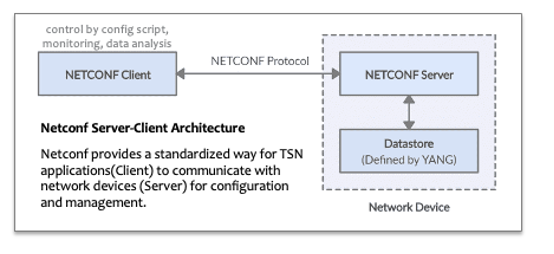
YANG-based Netconf and Restconf are powerful tools for managing TSN, offering standardized, secure, and flexible methods for configuring and maintaining critical network parameters. YANG, a XML-based data modeling language, provides a standardized way to model configuration and state data manipulated by network management protocols, Netconf and Restconf. By leveraging YANG-based Netconf and Restconf, network administrators can automate the deployment and management of TSN configurations, ensuring consistent and precise control over network behavior.
Netconf offers a robust framework for installing, manipulating, and deleting the configuration of network devices. It uses a secure transport layer, such as SSH, to provide reliable communication between a network management system and the devices it manages. Restconf, on the other hand, provides a simplified interface using HTTP methods, making it accessible and easy to use for web-based applications.
This approach reduces the complexity of TSN management by providing a clear and standardized method for configuring TSN features across diverse network devices. Furthermore, YANG-based Netconf and Restconf support the dynamic nature of TSN, allowing real-time adjustments to network configurations in response to changing conditions or requirements.
Without YANG-based Netconf/Restconf, network configuration and management lack standardization, leading to manual configuration tasks that are time-consuming, error-prone, and difficult to scale. Additionally, the absence of automation capabilities provided by Netconf or Restconf hinders efficient management and increases operational costs required for network maintenance.