
Digital Twin & Cloud
Digital Twin Simulation

What is a Digital Twin?

A digital twin is a virtual replica of a physical system that enables real-time monitoring and predictive insights across vehicles, IoT devices, manufacturing equipment, and more. The concept is like a “virtual twin” of a real object or system — for example, a car, a factory machine, or an IoT device. Just like real twins that look alike and respond to each other, the digital version and the physical version stay connected and continuously interact in real time.
Unlike a one-time simulation, the digital twin is always updated with live data from the real world. This two-way connection allows it to monitor what’s happening, predict future issues, and suggest ways to improve performance and prevent failures.
Why is it essential in the automotive and IoT industries?
Modern vehicles and IoT ecosystems are evolving into highly sophisticated, software-driven platforms, equipped with hundreds of sensors, controllers, and communication networks. These systems generate tens of terabytes of heterogeneous data per day, encompassing everything from high-frequency CAN bus messages to complex multimedia and telematics streams.
Such vast amounts of information only become truly valuable when they are processed, analyzed, and acted upon within strict time constraints. Digital twins address this challenge by enabling:
Continuous monitoring and remote diagnostics: Delivering real-time visibility into the operational state of vehicles and IoT devices, allowing early anomaly detection and proactive fault isolation to minimize unplanned downtime.
Predictive maintenanc through simulation: By combining historical trends with live telemetry, digital twins use high-fidelity virtual environments to both predict potential failures for just-in-time maintenance and validate control algorithms, safety mechanisms, and performance parameters — ensuring operational efficiency, cost reduction, and regulatory compliance before deployment.
Accelerated software development and deployment: Digital twins enable faster and more advanced software development by providing a continuous verification layer throughout the lifecycle. This allows teams to rapidly iterate, validate complex automotive and IoT software stacks, and deploy improvements with greater confidence and speed.
Key enablers for implementing a digital twin
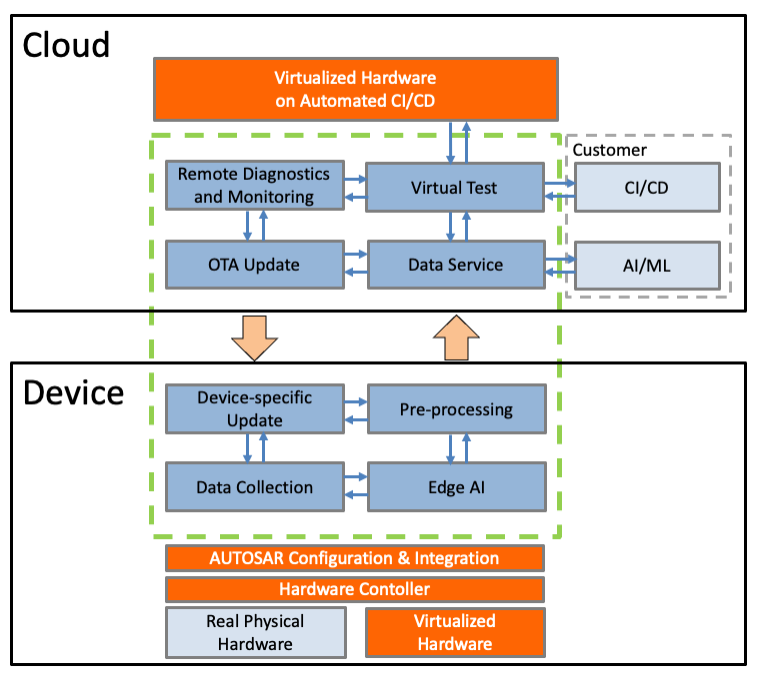
Accurate and continuous data feeds between device and cloud
Reliable collection and integration of real-time data from vehicles and IoT devices.
Compatibility across various sensors, network protocols, and data formats.
The ability to perform secure and robust OTA updates in various formats according to user needs, but furthermore select and collect the right data, in the right amount, at the right time to optimize bandwidth, storage, and processing resources.
High-fidelity simulation and virtualization environments
Virtual environments that accurately replicate hardware behavior for testing and optimization.
The ability to validate complex scenarios rapidly and at scale.
implementing multiple levels of virtual ECUs to perform early testing of hardware-control software without requiring physical hardware.
In the automotive domain, ensuring dedicated configuration and integration for hardware virtualization in compliance with the AUTOSAR platform.
Support for continuous software evolution
Keeping digital twins in sync with real systems through remote updates and CI/CD-based continuous delivery.
Providing a stable data foundation that allows customers’ ML and AI models to learn and operate more effectively for accelerated analytics, through deep integration with customers’ existing infrastructure such as Machine Learning, AI, and cloud computing.
Guaranteed real-time networking
Minimizing latency and ensuring reliable transmission of critical data.
In Ethernet-based networks, implementing Time-Sensitive Networking (TSN) to control data flows according to precise timing requirements, ensuring that the right network resources are executed at exactly the right moment.
DT Case Studies
Synergies enabled by digital twins
Accelerated predictive maintenance after production
A leading commercial vehicle manufacturer improved failure prediction accuracy by integrating digital twins with its proprietary cloud-based AI models, enabling real-time tracking of engine component wear.

Faster development and Early validation during development cycle
Automotive and IoT manufacturers incorporated virtualized testing environments into cloud and its existing CI/CD pipelines, pre-validating hundreds of firmware updates
USE CASE
-
A leading EV manufacturer is developing its next-generation autonomous driving platform. The vehicle architecture is built on a TSN-enabled zonal network, connecting dozens of high-bandwidth sensors (LiDAR, radar, cameras) and multiple ECUs.
To validate ADAS control logic before mass production, engineers deploy virtual ECUs to replicate ECU behaviors and run large-scale simulation of thousands of driving scenarios — from routine highway cruising to rare edge cases such as multi-vehicle cut-ins or sensor degradation in heavy rain.
At the edge, data aggregation policies govern how sensor streams are collected:
Under normal highway conditions, low-resolution camera frames and compressed LiDAR point clouds are stored in short rolling buffers.
When the Edge AI detects an anomaly (e.g., misalignment between radar and camera object detection), an OTA-triggered policy update immediately switches to full-resolution logging for an extended buffer period.
These policies differ specific to device: central compute nodes run sophisticated fusion consistency checks, while lightweight sensor ECUs perform simple threshold-based triggers.
Control algorithms refined in the virtual twin are deployed OTA fleet-wide, or selectively to test vehicles in specific geographies. This closed-loop cycle reduces the need for physical prototypes and accelerates readiness for regulatory validation.
Benefits:
Cut R&D and validation time by up to 6–9 months through large-scale virtual ECU simulation.
Optimize network/storage usage with adaptive, policy-driven data buffering.
OTA updates enable rapid iteration of ADAS algorithms without workshop recalls.
Increased safety assurance by continuously validating rare edge-case scenarios.
-
A global logistics provider operates fleets of autonomous cargo drones and unmanned vessels. These assets generate terabytes of sensor data daily, from camera feeds to engine telemetry. Managing this volume requires edge-level AI filtering and OTA-updatable data policies.
In routine transit missions, drones transmit only compressed flight telemetry and summarized obstacle maps.
When Edge AI detects abnormal vibration or unusual wind patterns, it triggers a policy change: raw IMU and GPS streams are preserved in extended rolling buffers, and high-resolution video is uploaded for central analysis.
OTA campaigns allow the command center to dynamically adjust policies fleet-wide — for instance, tightening anomaly detection sensitivity during storm seasons, or relaxing it for low-risk cargo routes.
Device-specific rules reflect hardware capabilities: high-powered aerial drones run deep anomaly detection models locally, while smaller ground robots rely on lightweight statistical filters.
In the cloud, a fleet digital twin simulates thousands of concurrent missions under varying conditions (signal loss, jamming, weather). Lessons learned from simulation are pushed back to the edge via OTA, enabling the fleet to evolve its behavior in real time.
Benefits:
70% reduction in network transmission costs through edge-triggered filtering.
Real-time adaptability: fleets respond instantly to environmental risks via OTA-updated rules.
Higher mission reliability validated through large-scale virtual fleet simulations.
Optimized use of heterogeneous hardware — each robot/drone contributes within its resource limits.
-
A semiconductor fab deploys a plant-wide digital twin to continuously optimize yield and uptime.
Virtualization layer: A virtual replica of the production line (robots, conveyors, PLCs, inspection cameras) runs in the cloud. Engineers test new control logic or layout changes virtually, validating them against thousands of “what-if” fault scenarios (power dip, tool misalignment, material contamination) before applying to physical systems.
Data aggregation + Edge AI: On the shop floor, each machine applies OTA-updatable collection policies.
Under normal operation, equipment transmits compressed statistical summaries (e.g., vibration, temperature trends).
If Edge AI detects anomaly patterns (e.g., spindle imbalance), a trigger expands the rolling buffer from 15s to 60s and streams raw high-frequency data to the twin for diagnosis.
Lightweight controllers use threshold triggers, while high-powered edge gateways run ML anomaly models.
Closed loop: The virtual twin receives enriched data, refines predictive models (e.g., Remaining Useful Life), and sends OTA-updated policies back down to edge devices.
Benefits:
Early validation of production optimizations via virtual line command → reduced downtime for physical experiments.
Adaptive, trigger-based data strategies prevent unnecessary cloud load while capturing critical events in detail.
Continuous improvement cycle between live shop floor data and simulation twin.
Improved KPIs: 15–20% reduction in unplanned downtime, double-digit yield gains, and shorter equipment validation cycles.
-
A defense program develops a digital twin of an armored vehicle platform to enhance both development and field operations.
Virtualization layer: Before hardware prototypes exist, full virtual ECUs replicate weapon control, navigation, and communication modules. These are tested in mission-scale simulations: GPS jamming, swarm drone attacks, electronic warfare conditions. Control logic is iteratively refined in this twin environment.
Edge AI + data policies: In the field, vehicle sensors (radar, IR, RF) are monitored by edge AI models. Data collection rules are OTA-updatable, with triggers for adaptive buffering. Example: when radar detects spectrum anomalies, the policy immediately expands data granularity and retention time; when low-risk, only statistical summaries are sent.
Closed loop: Insights from simulations are pushed OTA into live assets, while field data feeds back into the twin to validate and refine tactics. Different devices apply different policy layers depending on their compute profile — drones run deeper models, soldier-worn gear runs lightweight triggers.
Benefits:
Accelerated development cycles with virtual ECU-based system validation before physical hardware.
Mission readiness: vehicles adapt data strategies in real time via OTA-updated policies.
Reduced bandwidth burden with edge-triggered selective transmission.
Continuous improvement loop: live field data enriches the virtual twin, refining AI/tactics iteratively.
-
A university hospital deploys a digital twin of its surgical robot system to enhance both pre-operative planning and intra-operative reliability.
Virtualization Layer: Before each operation, a patient-specific virtual twin of the robot is created by combining CT/MRI imaging data with the robot’s kinematics. Surgeons use this twin to simulate multiple surgical paths, evaluate collision risks, and pre-test robotic arm trajectories for patient-specific anatomy.
Edge AI + Data Collection Policies: During surgery, the robot’s sensors (joint torque, end-effector force, haptic feedback) are continuously monitored. OTA-updatable policies govern data handling:
For routine movements, only summarized telemetry is stored.
If Edge AI detects anomalies such as unexpected resistance or unstable vital signs, the robot triggers a policy change, expanding rolling buffers and streaming high-frequency sensor data to the twin for real-time analysis.
Time Sensative Network: Within the operating theater, TSN-based deterministic networking ensures microsecond synchronization between the surgical robot, imaging displays, and anesthesia monitoring devices — guaranteeing that visual guidance and robotic movements are perfectly aligned.
OTA Updates: The robot’s firmware and embedded AI diagnostic models are continuously updated via secure OTA, ensuring compliance with medical safety regulations and rapid adoption of the latest surgical techniques.
Benefits:
Increased precision and safety through patient-specific virtual pre-simulation of robotic movements.
Faster detection and response to intraoperative anomalies with trigger-based Edge AI monitoring.
Continuous compliance and safety assurance via OTA-updated firmware and diagnostic models.
Deterministic TSN networking ensures flawless coordination between robot, imaging, and monitoring systems.