
Virtualization on AUTOSAR for automotive software
In the context of AUTOSAR in the automotive domain, the virtual ECU
Level 1: ASW on Virtualized Entire Platform
Level 2: Partial SW Platform
Level 3: Full SW Platform on Window/Linux
Level 4:Full SW Platform with Real MCAL on virtualized HW
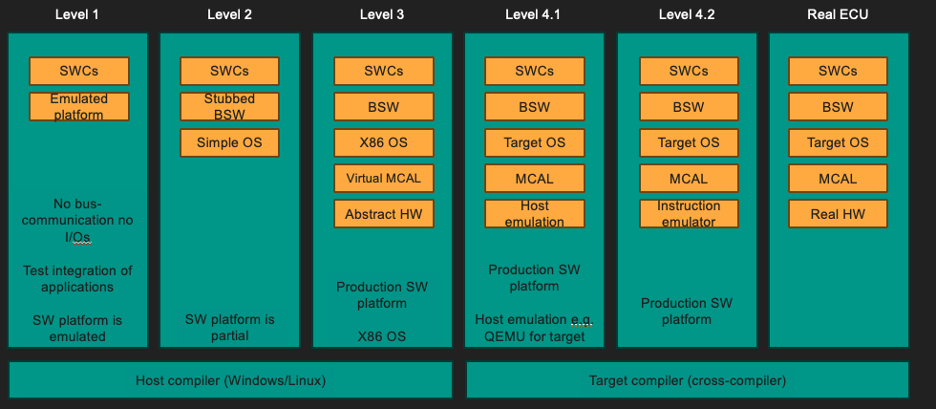
Our team can design and implement virtual ECUs at all levels across level 1~4, tailored for AUTOSAR Classic and Adaptive platforms as well as Non-AUTOSAR platform. This allows OEMs and Tier-1 suppliers to test hardware control software in a purely virtual environment long before physical prototypes are available—reducing development cycles, enabling early fault detection, and minimizing the cost and risk associated with late-stage hardware issues.
Building on our deep experience and expertise in Basic Software (BSW) for both the automotive and IoT domains, we provide end-to-end capabilities including:
Virtual ECU implementation and configuration across Levels 1 to 4
Integration between virtual environments and production software stacks
Simulation-based test environments and execution of real test scenarios
Level 2 – SWC Integration & Functional Testing
Functional Testing – Executing test cases to validate the behavior of individual SWCs and their interactions.
Error Handling Verification – Simulating fault conditions to confirm SWCs respond correctly to abnormal inputs or missing data.
Interface Validation betweeen SWCs – Checking data consistency and correctness across RTE interfaces between SWCs.
Level 3 – BSW Integration & Middleware Testing
BSW Module Testing – Validating communication stack modules (CAN, LIN, Ethernet) and diagnostic services in a virtual environment.
Middleware Behavior Verification – Testing OS scheduling, memory management, and inter-task communication without physical hardware.
Network Stack Simulation – Simulating full communication cycles across multiple virtual ECUs to validate network timing and message routing.
Fault Injection – Introducing simulated hardware or communication failures to confirm system recovery mechanisms.
Resource Usage Analysis – Monitoring CPU load, memory footprint, and I/O utilization under realistic scenarios.
Boot Sequence & Startup Testing – Verifying that BSW modules initialize correctly in the proper order before application execution.
At Level 4 – Full Virtual ECU & Hardware Interaction Simulation
Hardware Abstraction – Creating a virtualized representation of ECU hardware, including CPU, memory, and required peripherals.
Virtual Peripheral Implementation – Modeling peripherals such as CAN interfaces, I/O modules, and communication buses.
Software-in-the-Loop (SIL) – Running target ECU software on virtualized hardware within a controlled simulation environment.
Real-time Execution – Ensuring the virtual ECU operates in real-time or with controlled simulation timing for accurate testing and debugging.
Hardware-in-the-Loop (HIL) – Combining virtual ECUs with physical hardware components (sensors, actuators) for hybrid testing scenarios.
Full Stack Validation – Verifying the complete software stack, including application code, BSW, and virtualized hardware.
Driver Testing – Ensuring correct operation of drivers and peripheral interfaces.
Functional Safety Validation – Confirming that the system meets safety requirements and performs correctly under critical conditions.
By leveraging automated test execution within CI/CD pipelines, we maximize testing efficiency—dramatically reducing time-to-market, lowering costs, and increasing overall product quality.